About Us
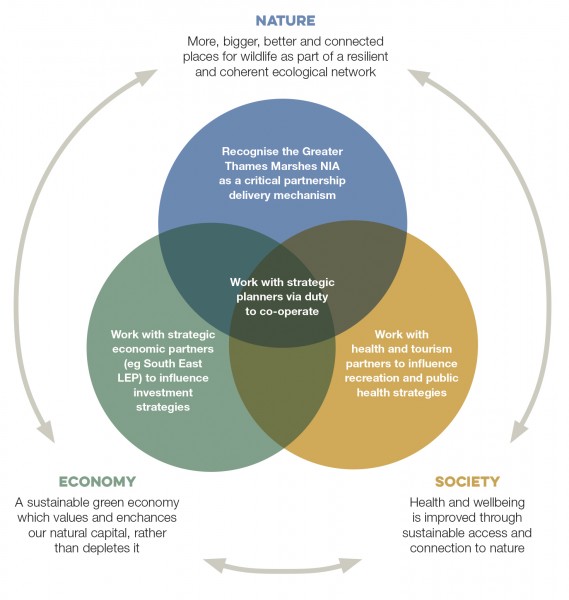
We want nature to play a part in the Greater Thames, now and in the future.
Nature Improvement Areas (NIAs) were nationally launched in April 2012. Partners were awarded £571,875 funding over 3 years (2012-2015) to support delivery of the Greater Thames Marshes Business Plan.
Concurrently, the Thames Gateway Local Nature Partnership (LNP) was established. Chaired by Sir Terry Farrell, this is a partnership of businesses and local organisations to integrate improvements in the environment with our economy and society.
Learning lessons from experience to date, and best practice across England, the Thames Gateway LNP and Greater Thames Marshes NIA have agreed that a closer working relationship would be mutually beneficial to both organisations. This union will better utilise the strategic powers of the LNP and the substantial delivery capacity of the NIA.
“The Thames Gateway LNP is a group of passionate people trying to improve the state of nature in the Thames Estuary and make landscape the primary infrastructure. It seems natural that our future working will be alongside the Greater Thames Marshes NIA, which has delivered fantastic projects for nature throughout the area” – Sir Terry Farrell
Our Action Plan for improving nature in the Greater Thames (2015-2020) is now available for download. Contact us if you wish to order hard copies of this document.
Today, human society is chasing modern developments, novelties of technology that make life easier and more comfortable. Many people surround themselves with hundreds of unnecessary things that are harmless to the environment. Environmental degradation affects not only the quality of life but also the health and longevity of people.
State of the environment
At the moment, the state of the environment leaves much to be desired: water pollution, depletion of natural resources, the destruction of many species of flora and fauna, air pollution, violation of the regime of water bodies, greenhouse effect, acid rain, the formation of ozone holes, melting glaciers, soil pollution, desertification, global warming, deforestation.
All this leads to the fact that ecosystems change and collapse, territories become unsuitable for the life of people and animals. We breathe in dirty air, we drink dirty water, we suffer from intense ultraviolet radiation. Now the number of cardiovascular, cancer, neurological ailments is increasing; allergies and asthma, diabetes, obesity, sterility, AIDS are spreading. Healthy parents give birth to sick children with chronic diseases, pathologies and mutations.
Consequences of nature depletion
Many people do not even think about what global environmental problems can lead to. The air, in addition to other gases, contains oxygen, which is necessary for every cell of the body of people and animals. If the atmosphere is polluted, people literally will not have enough clean air, which will lead to numerous diseases, rapid aging and premature death.
The lack of water leads to desertification of territories, destruction of flora and fauna, changes in the water cycle in nature and climate change. Not only animals, but also people die from lack of clean water, from exhaustion and dehydration. If the water bodies are still polluted, soon all the supplies of drinking water on the planet will be exhausted. Polluted air, water and land lead to the fact that agricultural products contain harmful substances, so many people cannot eat healthy food.
And what awaits us tomorrow? Over time, environmental problems can reach enormous proportions and one of the scenarios of a film-catastrophe may turn into reality. This will lead to the death of millions of people, disruption of the usual life on earth and endanger the existence of all life on the planet.
The relationship between our prosperous existence and the state of the environment is obvious. If nature suffers, we suffer as well. The most terrible cataclysms (increasingly occurring on the planet) are often the sad result of unreasonable human activities. It is time to think what is more important to us – material well-being or a quiet life surrounded by beautiful nature.